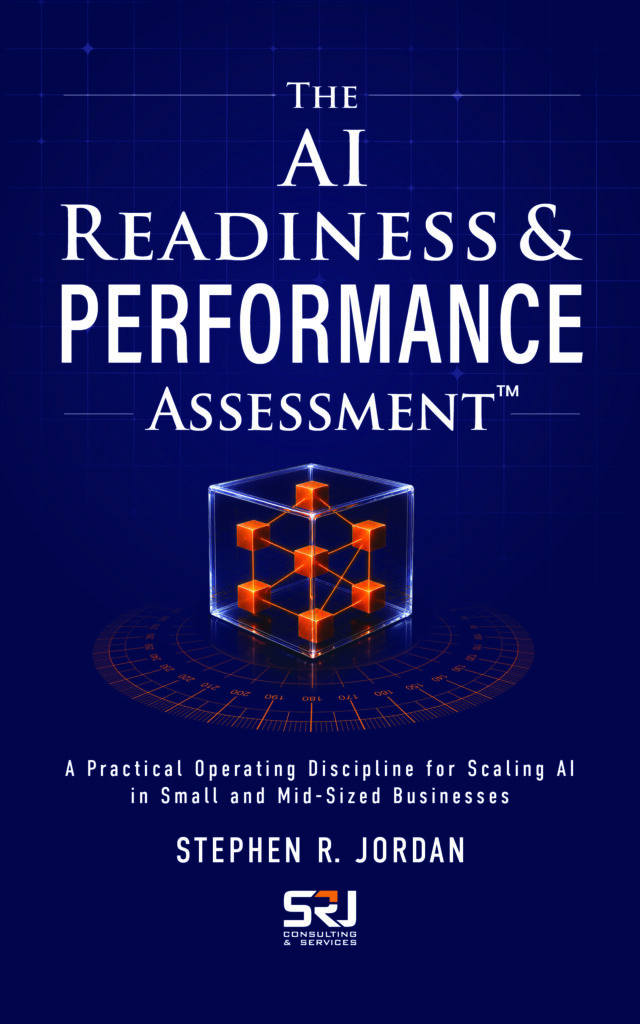
Most executives are running AI across their organization without a structured way to know whether it is producing value or quiet loss. The AI Maturity Assessment closes that gap, and The AI Readiness & Performance Assessment™, Volume II of The Operating Discipline for AI Library™, is the working method behind this article, available now in paperback, hardback, and Kindle.
The pain behind every AI Maturity Assessment: adoption is not performance
Across the conversations I have been part of with operating executives over the past two years, one pattern keeps surfacing. A CEO, a CFO, or a COO says some version of this: we are using AI across the business, but we have no structured way to know whether it is producing what we hoped, where it is producing it, or whether we should be scaling further. The decisions feel like guesswork.
That is the gap.
Mid-sized businesses adopted AI quickly. The tools spread across functions without governance, without measurement, and without the kind of operating discipline a serious leader would apply to any other function. Now executives are being asked questions they have no structured way to answer, by boards, by regulators, by their own customers. An AI Maturity Assessment exists to convert that uncertainty into reproducible scoring.
The value of an AI Maturity Assessment: judgment becomes evidence
The value of the AI Maturity Assessment is not in producing a number. It is in converting executive judgment into evidence that is defensible to a board, an investor, or a regulator.
Boards do not accept “we feel AI is going well.” They accept scored assessments grounded in observable conditions. Investors do not accept “we are using AI in production.” They accept maturity ratings tied to specific business functions. Regulators, including those who reference the NIST AI Risk Management Framework, do not accept “we have a policy.” They accept evidence that the policy is applied and measured.
The assessment produces all three. It is the difference between knowing you are using AI and knowing whether the AI is producing what you intended it to produce.
What the AI Maturity Assessment scores: six conditions
Six conditions decide whether AI inside a business produces real value or quiet loss. The assessment scores each one on a 1-to-5 maturity scale that converts informal judgment into reproducible evidence the board will accept.
The six conditions:
- Outcome alignment, whether each AI use is tied to a measurable business outcome that an executive would defend in front of the board.
- Data readiness, whether the underlying data is governed, accessible, and accurate enough to support the use without manual reconciliation.
- Process integration, whether AI is wired into the workflow or running beside it as a shadow tool that operators reference without accountability.
- Risk and governance, whether each use has documented oversight, decision rights, and an escalation path when output is wrong.
- Performance measurement, whether the use is monitored against expected results on a defined cadence.
- Operator capability, whether the people running the workflow can interpret AI output and intervene when needed.
Each condition is scored independently. The composite produces the maturity rating that drives the decision protocol.
The decision protocol inside the AI Maturity Assessment: expand, refine, or pause
A score is only useful if it drives a decision. The decision protocol translates the composite score into one of three actions for each AI use the business is running:
- Expand, when the use is scoring high and the business case justifies scaling investment.
- Refine, when the use is producing value but specific conditions are below threshold and need targeted remediation.
- Pause, when the use is producing loss or operating without the conditions to scale safely.
The protocol is intentionally simple, because executives need to act on the result, not interpret it. It maps cleanly onto established governance frameworks including ISO/IEC 42001, the AI management system standard, so the decision is defensible inside organizations already aligned to international standards.
Volume II of The Operating Discipline for AI Library™ is now available
The AI Readiness & Performance Assessment™ is Volume II of The Operating Discipline for AI Library™, the nine-volume executive reference series for operators accountable for AI outcomes inside their organizations. Volume II is available now in paperback at $24.99, hardback at $64.99, and Kindle at $9.99 on Amazon, and will be available through Barnes & Noble, Books-A-Million, Bookshop.org, and library acquisition systems via Ingram in the coming weeks.
How the AI Maturity Assessment closes the gap
The book walks executives through the AI Maturity Assessment method, end to end:
- The six readiness conditions that decide whether AI produces real value or quiet loss.
- A 1-to-5 maturity scale that converts executive judgment into board-grade evidence.
- A decision protocol that translates the score into expand, refine, or pause.
- A 90-day execution roadmap that moves the organization from baseline measurement to defensible decision.
- A repeatable governance framework that keeps the discipline running long after the assessment closes.
The frameworks are tested. The worksheets are usable. The scoring is reproducible.
Who needs an AI Maturity Assessment first
If you are an owner, president, CFO, or COO running an organization between 20 and 1,000 employees, the AI Maturity Assessment is built for you. It is especially relevant if you are reporting on AI performance to a board, an investor, or a stakeholder group, or trying to figure out where AI is genuinely working and where it is quietly underperforming, or running a business inside a regulated industry where AI use needs documented operating discipline.
Picture a 40-person professional services firm. AI tools have spread to client work, to internal operations, and to personal accounts the company does not control. The CFO is briefing the board next quarter. The right starting point is not a vendor demo or a policy document. It is a baseline. The assessment produces that baseline in a defensible, repeatable form.
Volume II of the AI Maturity Assessment series builds on Volume I
Volume I, The AI Business Enablement Audit™, gave operators the discipline for deciding whether AI belongs inside specific functions of their business. Volume II picks up where Volume I ended and answers the question that follows: once AI is inside the business, how do you know whether it is ready to scale?
Together the two volumes form the foundation of the AI Business Services™ pillar inside The Operating Discipline for AI Library™. Volume III is in development. Volumes IV through IX follow. Each volume is structured the way a serious operator would actually use it, with tested frameworks, usable worksheets, and reproducible scoring that is defensible inside any boardroom.
Get The AI Readiness & Performance Assessment™
Paperback $24.99, Hardback $64.99, Kindle $9.99 on Amazon. If you read it and find it useful, a brief Amazon review is the most valuable thing you can do to help other executives find it.
Apply the AI Maturity Assessment to your business
The book gives you the method. The engagement applies it inside your organization with the conditions scored, the decisions documented, and the 90-day roadmap committed.