Most mid-market companies bleed between $250,000 and $670,000 a year to unauthorized AI. The lower end is duplicated subscriptions and productivity drag — recoverable with discipline. The upper end is what a shadow-AI breach costs on top, per IBM’s 2025 Cost of a Data Breach Report.1
SRJ Consulting & Services surfaces the waste, contains the exposure, and recovers the margin. Audits typically pay for themselves before they surface a single risk finding.
Most mid-market companies have between 8 and 24 AI tools running inside their business right now. Leadership can typically name three or four. The gap between what you know is happening and what is actually happening is where the cost lives.
Sales bought a ChatGPT Enterprise contract. Marketing has a separate Jasper subscription. Legal added Harvey. Finance is paying Microsoft Copilot per seat for everyone, including the teams already running the other three. Mid-market companies routinely pay for the same capability four times before anyone consolidates.
Employees signing up for free AI tools on personal accounts. Customer data, financial records, and proprietary work flowing through systems your security team has never reviewed. The exposure compounds quietly until something breaks, at which point it becomes a board issue.
Departments selecting AI tools based on demos rather than fit. Teams spending six months trying to get value from a tool that was never going to work for their use case. The cost is the productivity that should have been gained but wasn't, plus the switching cost when leadership finally pulls the plug.
Without a unified view of AI spend, finance cannot negotiate. Every contract gets renewed at list price. Every per-seat commitment gets locked in for another year. Procurement leverage that would save $30,000 to $150,000 annually gets left on the table because nobody has the consolidated data.
Mid-market AI sprawl doesn’t stay flat. Every quarter another team adds another tool. The eight to twenty-four tools running today become twelve to forty next year. Recoverable waste grows by 30 to 50 percent per year of inaction.
Shadow AI in the environment doesn’t just sit there. It touches more data, more customers, more vendors with every month that passes. The longer the lag between deployment and governance, the wider the surface.
IBM’s 2025 Cost of a Data Breach Report found organizations with high levels of shadow AI paid $670,000 more per breach than organizations with low levels or none.1
1 IBM Security, Cost of a Data Breach Report 2025. Organizations with high levels of shadow AI experienced average breach costs of $4.74 million — $670,000 higher than organizations with low levels or no shadow AI ($4.07 million).
Is AI making the business stronger?
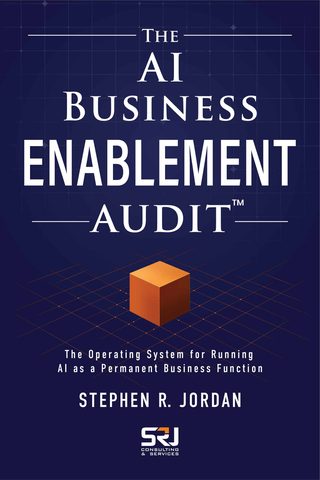
Four service lines that audit, assess, govern, and optimize how AI produces value inside the organization. Most engagements begin with the AI Business Enablement Audit™, which typically recovers six figures in subscription consolidation alone.
Explore AI Business Services →Is AI exposing the business to harm?
Five service lines that identify, contain, and remediate AI-driven security exposure across governance, product, application, and cloud. Traditional risk frameworks were not designed for how AI changes the attack surface. These engagements fill that gap.
Explore AI Risk Governance & Security →SRJ Consulting & Services was founded by Stephen R. Jordan after three decades of senior leadership at Citi, Intel, McAfee, and Optiv. The practice was built on a deliberate constraint: no software sales, no vendor partnerships, no implementation revenue. The advisory itself is what clients buy, which means there is no commercial reason to recommend anything other than what is actually right for the business.
Thirty years inside Fortune 500 operations, security, and risk programs at Citi, Intel, McAfee, and Optiv before founding the AI advisory firm. The frameworks come from running things, not from studying things.
No software resold, no implementation partnerships, no kickbacks. Recommendations are aligned to your business outcomes, not a partner channel.
Every audit produces a written deliverable a CFO can review and a board can act on. The numbers are sourced, the methodology is documented, the recommendations are prioritized by recoverable value.
The AI Governance Audit Gap: 95% Run AI, 31% Have One A founder I worked with last year guessed his company was running three AI tools. We found nineteen. He is not the outlier. He is the pattern, and new research now puts a number on it. Ninety five percent of organizations have adopted AI,...
Most Companies Still Cannot Say Where Their AI Tools Live Artificial intelligence is already inside the business. It may be inside writing tools, reporting systems, customer service platforms, marketing workflows, Microsoft 365, Google Workspace, CRM systems, browser extensions, SaaS applications, and employee created automations. Some of it is approved. Some of it is visible. Some...
AI governance for executives is not a technology problem. It is a money problem hiding in plain sight. Last quarter, one leadership team I worked with discovered they were spending roughly $86,000 a year on AI tools they did not know they owned. Not on a strategic AI initiative. Not on a vendor they had...
Most executives find six figures in recoverable waste in the first thirty minutes of conversation. The consultation is free. There is no deck, no pitch, no sales process. A structured conversation about where your organization currently stands and what the right next step looks like.
Biweekly framework analysis, new templates, and field notes from active client engagements. Free, no software pitches, unsubscribe anytime.