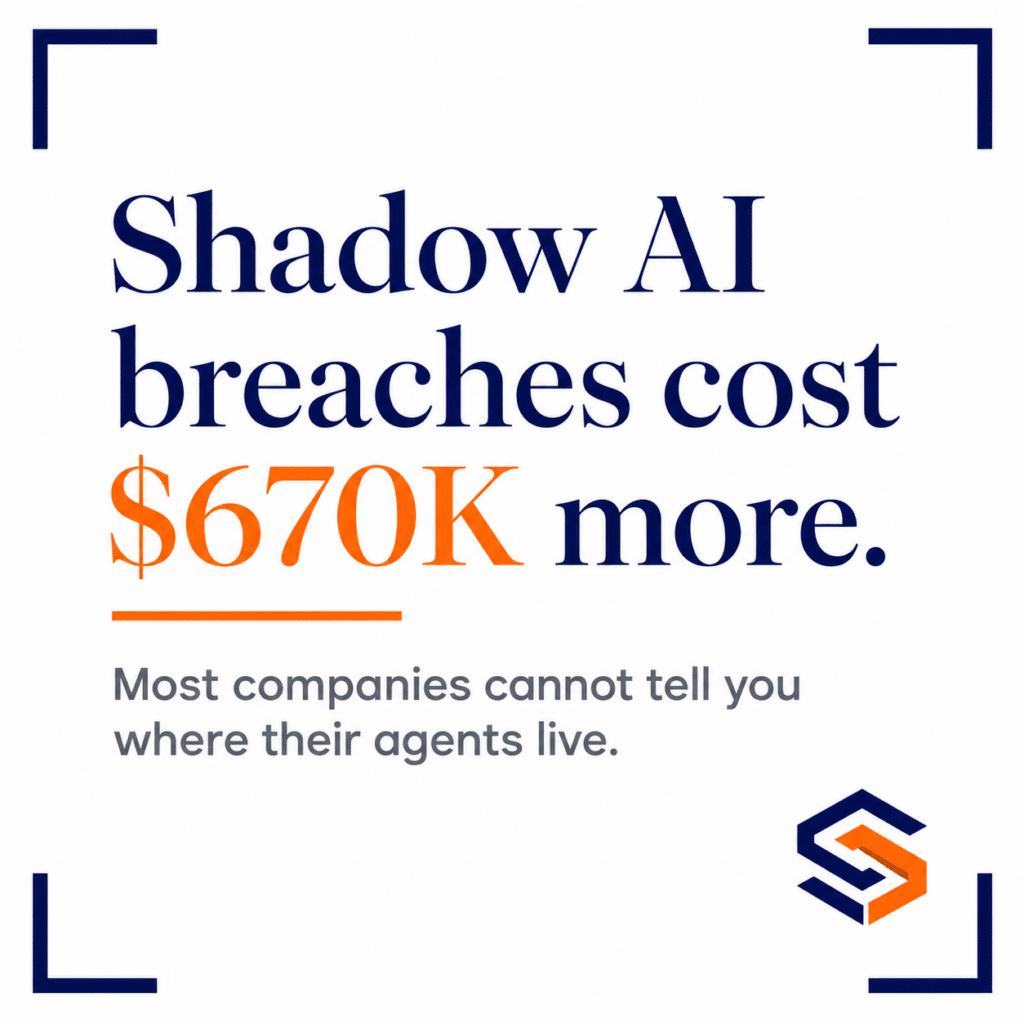
Most Companies Still Cannot Say Where Their AI Tools Live
Artificial intelligence is already inside the business.
It may be inside writing tools, reporting systems, customer service platforms, marketing workflows, Microsoft 365, Google Workspace, CRM systems, browser extensions, SaaS applications, and employee created automations.
Some of it is approved.
Some of it is visible.
Some of it is not.
That hidden layer is where the real risk begins.
This is shadow AI. It happens when employees, teams, vendors, or departments use artificial intelligence tools without formal approval, proper oversight, access controls, or a clear business owner.
For small and mid sized businesses, shadow AI usually does not begin as reckless behavior. It begins with productivity. An employee wants to work faster. A manager wants to summarize documents. A sales team wants help writing follow up emails. An operations employee wants to automate repetitive work.
The problem is not that employees want to use better tools.
The problem is that the business often has no reliable way to see which tools are being used, what data those tools touch, who approved them, and who is responsible when something goes wrong.
IBM Put a Dollar Figure on Shadow AI Risk
IBM’s 2025 Cost of a Data Breach Report made the shadow AI problem much more concrete.
According to IBM, one in five organizations reported a breach due to shadow AI, and only 37% had policies in place to manage or detect shadow AI. IBM also reported that organizations with high levels of shadow AI had an average of $670,000 in higher breach costs compared with organizations that had low or no shadow AI.
That number matters because it moves shadow AI out of the “future risk” category.
This is no longer just a theoretical concern about employees experimenting with ChatGPT or using a new productivity tool. Shadow AI is now connected to actual breach cost, data exposure, operational disruption, and governance failure.
IBM also found that security incidents involving shadow AI exposed more personally identifiable information and intellectual property than the global breach average.
For business owners, executives, and department leaders, the message is direct.
If you cannot identify where AI is being used inside your business, you cannot fully understand your risk.
Why Shadow AI Is Different From Ordinary Software Risk
Businesses have always had software risk.
Employees download tools. Departments buy subscriptions. Vendors introduce new platforms. Technology changes faster than internal policies.
AI makes this problem more serious because AI tools do not just store information. They can process it, summarize it, transform it, generate outputs from it, and sometimes act on it.
An unmanaged AI tool may touch customer records, financial information, employee data, contracts, emails, operational reports, intellectual property, or login credentials.
An AI agent creates even more concern. Unlike a basic application, an AI agent may be able to complete tasks across systems, trigger workflows, make recommendations, draft communications, or operate with persistent access.
That means an unmanaged AI agent can begin to function like a highly privileged digital employee.
But here is the problem.
Many companies do not know that employee exists.
The Real Issue Is Visibility
Most companies do not need to start with a complicated AI governance program.
They need to start with visibility.
Leadership should be able to answer basic questions:
| Question | Why It Matters |
|---|---|
| What AI tools are employees using? | You cannot manage tools you cannot see. |
| Which AI tools are approved? | Employees need a clear path for safe adoption. |
| Which tools touch company data? | Data exposure is where risk becomes expensive. |
| Which AI features are active inside existing software? | AI may already be turned on inside tools you use every day. |
| Who owns each AI tool or workflow? | Every system needs accountability. |
| How is access removed when someone leaves? | Persistent access creates unnecessary exposure. |
| How often is AI usage reviewed? | AI risk changes too quickly for annual review only. |
These are not advanced technical questions.
They are management questions.
A business would never say, “We do not know who has access to our bank account.” It would never say, “We do not know who runs payroll.” It would never say, “We do not track our major vendors.”
AI should be treated with the same operational discipline.
Shadow AI Usually Reveals a Leadership Gap
Shadow AI grows when employees move faster than the company’s operating structure.
That does not mean employees are acting in bad faith. In many cases, they are solving real business problems. They are trying to reduce manual work, improve output, move faster, and keep up with customer expectations.
The leadership issue is that the company has not created a safe, approved path for AI adoption.
When there is no clear policy, employees improvise.
When there is no approved tool list, employees choose their own.
When there is no review process, departments buy technology independently.
When there is no inventory, leadership loses visibility.
When there is no owner, accountability disappears.
That is how AI moves from helpful productivity tool to unmanaged business exposure.
AI Governance Does Not Have to Be Complicated
A practical AI governance program does not need to slow the business down.
In fact, good governance should help the business move faster because employees know what is allowed, leaders know what is being used, and risk is handled before it becomes expensive.
For most small and mid sized businesses, the first version of AI governance should include:
| Governance Area | Practical Control |
|---|---|
| AI inventory | List all known AI tools, agents, workflows, owners, users, and data access. |
| Approved use policy | Define what employees can and cannot do with AI. |
| Data rules | Identify which information cannot be entered into AI tools. |
| Ownership | Assign a business owner for every AI tool or workflow. |
| Access control | Review permissions, credentials, integrations, and termination steps. |
| Vendor review | Identify where third party providers use AI. |
| Quarterly review | Update the inventory and review new AI usage. |
| Incident response | Define what happens if AI causes a data, security, customer, or operational problem. |
This is not bureaucracy.
This is basic business control.
The Cost of Governance Is Smaller Than the Cost of One Incident
IBM’s $670,000 figure should get leadership attention because it reframes the investment decision.
The question is not, “Can we afford to review our AI exposure?”
The better question is, “Can we afford not to know where AI is operating?”
A basic AI inventory, access review, and governance framework will cost far less than one serious incident. It will also give the company a better foundation for future AI adoption.
That matters because AI is not going away.
More software vendors will add AI features. More employees will use AI tools. More workflows will become automated. More decisions will be influenced by AI generated outputs.
The companies that benefit most from AI will not be the ones that let every department experiment in isolation.
They will be the ones that create visibility, assign ownership, control access, and measure results.
What Business Leaders Should Do Now
The first step is simple.
Find out where AI already lives inside the business.
Start with a company wide AI inventory. Ask every department what AI tools they use, including free tools, paid tools, browser extensions, SaaS features, automations, and vendor provided AI capabilities.
Then review each tool for four things:
| Review Area | Question to Answer |
|---|---|
| Purpose | What business problem does this tool solve? |
| Data | What information does it access or process? |
| Access | Who can use it, connect it, or change it? |
| Ownership | Who is responsible for monitoring it? |
Once leadership has that inventory, the company can make better decisions.
Some tools should be approved.
Some should be restricted.
Some need stronger access controls.
Some should be replaced.
Some should be turned off.
The goal is not to eliminate AI.
The goal is to bring AI under management.
Final Thought
Shadow AI is not dangerous because employees are curious.
Shadow AI is dangerous because leadership often cannot see it.
IBM’s research makes the business case clear. Organizations with high levels of shadow AI experienced significantly higher breach costs, and many organizations still lack policies to manage or detect shadow AI.
That should be a wake up call for every business using AI, whether formally or informally.
Before the next AI rollout, before the next software purchase, and before the next department starts experimenting, leadership should answer one question:
Where does AI already live inside our business?
If the answer is unclear, that is the place to start.