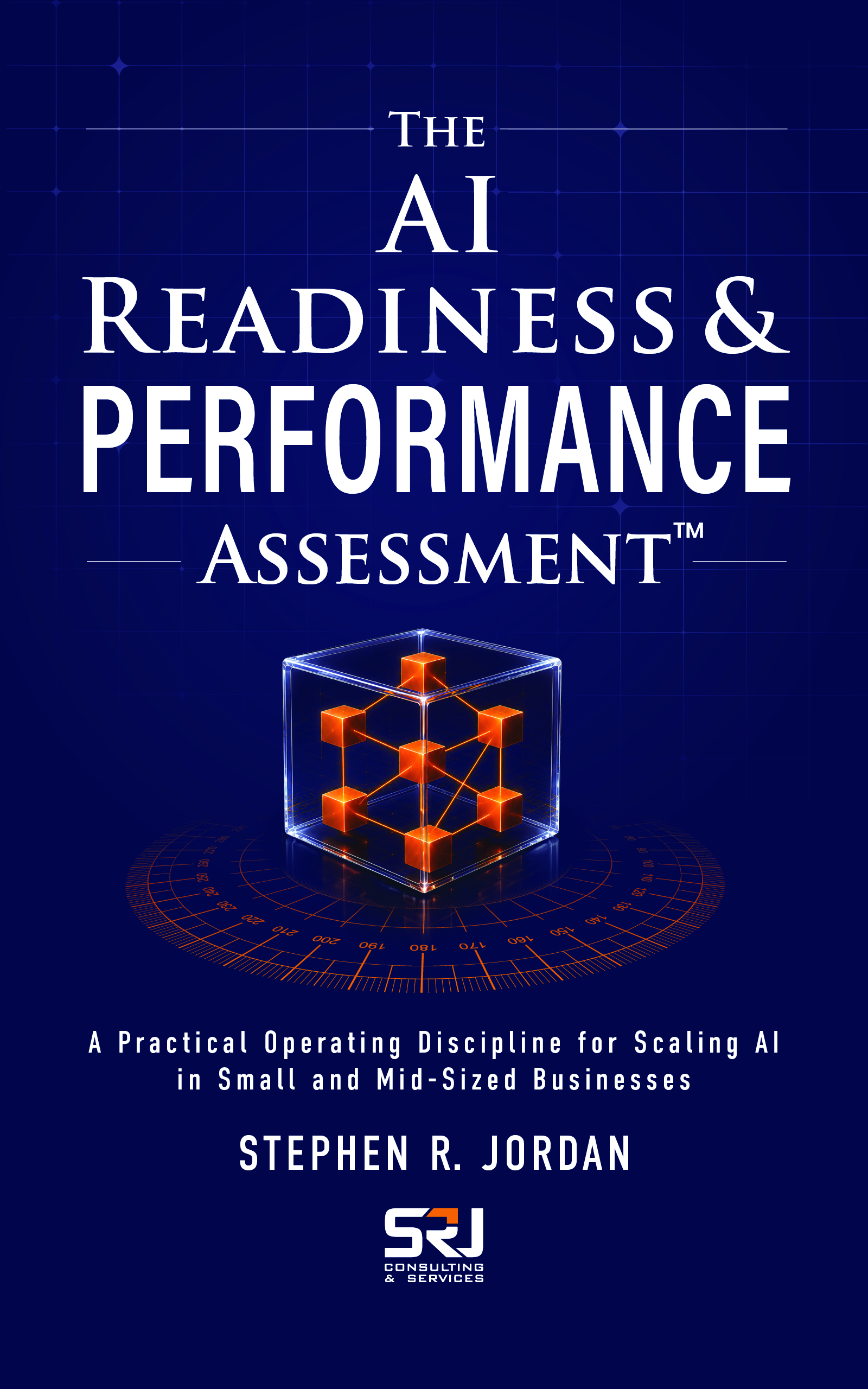
The AI Readiness & Performance Assessment™
A Practical Operating Discipline for Scaling AI in Small and Mid-Sized Businesses
Available NowThe performance discipline of the series. A structured, evidence-based way to test whether the AI already running inside a business is producing measurable results, or just generating activity that looks like progress. It scores six readiness conditions into a single decision, expand, refine, or pause, so leaders stop guessing about AI and start managing it. Plain English, no engineering background required.
Hardback, 332 pages, $74.99, ISBN 979-8-9965658-5-6. Paperback, $24.99, ISBN 979-8-9965658-3-2. Kindle edition, $9.99, ISBN 979-8-9965658-4-9.
What every Librarian needs to know about this book!
Volume II of The Operating Discipline for AI Library™ · 332 pages · Hardcover ISBN 979-8-9965658-5-6. The library sell sheet fits on one page and carries the full bibliographic record, ISBNs and list prices for every format, Library of Congress and Dewey classification, a summary of what is inside, and the collections the book suits.
The executive briefing, in one page at a time.
A condensed visual companion to the framework. The performance gap, the six readiness conditions, the Net Efficiency Yield Ratio, and the Expand, Refine, or Pause decision protocol leadership teams use to scale AI on evidence. Built for board distribution and leadership team review.
The AI Readiness & Performance Assessment™ is the discipline every leadership team is now being asked to demonstrate, and the one most cannot yet apply to their own use cases.
The pain AI Readiness & Performance Assessment is built to address
AI is already inside the business. It is drafting emails, summarizing documents, and shaping client work, whether leadership planned for it or not. Adoption already happened. Performance was assumed. And somewhere in the gap between the two, money is leaking out: rework, inconsistent output, unclear ownership, and operational friction nobody sees until it becomes expensive.
The book is written for the leader who has watched AI enter the business, approved the tools, absorbed the friction of adoption, and now has to answer the question that has arrived in every leadership room. Not what tools are being used. Not how many employees have logged in. The real question: is the AI running inside this business actually producing measurable results, or generating activity that looks like progress?
Most leaders do not have a clean answer to that question right now. The gap between adoption and performance is what The AI Readiness & Performance Assessment is built to close.
The question has moved from adoption to performance
Four stakeholders have arrived at the AI conversation, and they are asking different versions of the same question.
The CFO: what did AI return after cost. The board: which use cases are producing, and which are not. The operating partner: is the AI program scaling on evidence or on optimism. The acquirer: are the AI use cases documented, measured, and defensible. None of those questions are answered by an adoption metric or a usage report.
The new executive standard is straightforward. Show that each material AI use case is either producing measurable results or being refined toward them, not simply that AI is in use. Volume II is how that standard gets met by a leadership team running with the resources it already has.
What The AI Readiness & Performance Assessment book is
Volume II is an operational execution book for the leader accountable for AI results, not just AI activity. The difference between those two things is larger than it sounds. AI activity is easy to see. A tool is signed up for, a workflow is automated, a dashboard fills. AI performance is harder. It requires readiness scoring across six conditions, a measurement of what AI actually returns net of the friction it creates, and a documented decision an outside party can read and accept.
The book does not require a Big Four firm, a Chief AI Officer, or a dedicated analytics department. It requires the same operating discipline a leadership team already applies to finance, hiring, and vendor management, and it gives that discipline the structure to produce the readiness scoring and use-case decisions the business now needs to have ready.
Every chapter connects an AI readiness condition to a named operating instrument. Every tool is built for a small or mid-sized business with a real budget and a lean team. Every framework is designed to produce something you can walk into a room with and defend, not just something you can read and feel good about.
What you will learn from AI Readiness & Performance Assessment
How to score six readiness conditions on a five-point maturity scale: workflow clarity, data reliability, people readiness, leadership accountability, performance measurement, and operational friction. How to combine those six scores into a single readiness index that drives the most important AI decision a leader makes about a use case: expand, refine, controlled expansion, or pause. How to measure the Net Efficiency Yield Ratio, the discipline's core performance metric, which nets the value AI produces against the supervision, rework, and correction it creates. How to run the Operational Load Factor diagnostic that names the friction AI adds before scaling widens it.
The book introduces and develops the named operating instruments leadership teams use to convert AI adoption into AI performance: the Workflow Readiness Review™, the Data Reliability Checklist™, the AI Adoption Pattern Map™, the AI Governance Matrix™, the Performance Reality Test™ (Net Efficiency Yield Ratio), the AI Friction Diagnostic™ (Operational Load Factor), the Master AI Readiness Scorecard™, the Use Case Decision Record™, the AI Refinement Register™, and the 90-Day AI Decision Action Plan™. Each instrument carries a worked example and a usable template.
The lesson that runs through every chapter is the same. Adoption is not performance. Usage is not value. A subscription is not a return. A business that cannot measure what AI is returning net of friction is still managing a story rather than a result.
Who AI Readiness & Performance Assessment is written for
The book is written for executives and operating leaders, not engineers or data scientists. The goal is a defensible readiness baseline, a measured performance view, and a decision protocol the business can actually run.
The roles include owners and presidents, CEOs, CFOs, and COOs, managing partners, board members and operating partners, lenders, investors, and acquirers, and consultants advising mid-market clients. The sectors include professional services, accounting, legal, construction, manufacturing, distribution, healthcare, insurance, and financial services.
If you are responsible for AI outcomes, accountable for the AI budget, or in a position where someone is going to ask you to justify which use cases are being scaled, the book is for you.
How to use AI Readiness & Performance Assessment in your business
Read it with your AI Tool Inventory from Volume I and the two or three AI use cases everyone in leadership already argues about, in front of you. Each chapter is designed to help you score one readiness condition, measure one performance signal, or document one use-case decision, and convert that finding into a decision your leadership team can act on.
The tools in the book are not meant to be read and set aside. They are meant to be used, filled in, and brought into your next leadership meeting. The twenty-one-instrument Companion Worksheet library accompanying the book provides every artifact as an editable file, with the Master AI Readiness Scorecard™ as the operating master that combines the six condition scores into the single readiness index.
If you have not completed Volume I, the book still works. You will need to do some foundational inventory work as you move through the early chapters, and the book will guide you through that.
The case continuity across the Library
Readers who recognize the seventy-five-person construction firm, the forty-person accounting firm, and the sixty-person professional services practice from Volume I will see them again here. The case patterns are continuations of the same operating realities those businesses face as AI work moves from visibility (Volume I) to readiness (this Volume) to governance (Volume III) to optimization (Volume IV).
Each composite is drawn from patterns observed across many consulting engagements spanning more than two decades of professional practice. No single composite represents a single real engagement. Every composite combines elements from multiple distinct situations, and the specific numeric details are illustrative constructions designed to convey operating patterns in concrete terms.
What is inside AI Readiness & Performance Assessment, chapter by chapter
The book opens by naming the distinction most AI conversations skip: adoption is not performance. It then works through the six readiness conditions in sequence. Workflow clarity tests whether the workflow AI is being applied to is well-enough defined for AI to improve rather than obscure it. Data reliability tests whether the inputs AI depends on are trustworthy enough to build decisions on. People readiness tests whether the team using the tool has been prepared to catch the errors AI produces at the frequency AI produces them. Leadership accountability places named ownership on each material use case. Performance measurement installs the Net Efficiency Yield Ratio, the discipline's core metric, which nets the value AI produces against the supervision, rework, and correction it creates. Operational friction uses the Operational Load Factor to name the drag AI adds before scaling widens it. Each condition is scored on a five-point maturity scale, and the six scores combine into a single readiness index on the Master AI Readiness Scorecard™. The scorecard drives the decision protocol: expand, refine, controlled expansion, or pause. The book closes with the Use Case Decision Record™, the AI Refinement Register™, and the 90-Day AI Decision Action Plan™, which put the readiness discipline on the operating calendar so the assessment becomes a routine rather than a one-time exercise.
Where AI Readiness & Performance Assessment sits in The Operating Discipline for AI Library™
Volume II is the readiness discipline of Pillar I, AI Business Services™. The four Volumes in Pillar I sequence the operating disciplines a business needs to install AI honestly: visibility (Volume I), readiness (this Volume), governance (Volume III), and optimization (Volume IV). Volume I builds the AI inventory. Volume II sorts that inventory into what should be scaled, what should be refined, and what should be paused. Volumes III and IV extend the readiness decisions into governance and performance.
Pillar II, AI Risk Governance & Security™, runs in parallel and addresses the security side of the AI Operating System™ through five further Volumes. The two pillars are deliberately independent.
How the book and the AI Readiness & Performance Assessment engagement work together
The book is the methodology, written for leadership teams that want to run the discipline themselves. The AI Readiness & Performance Assessment engagement is the execution, designed for leadership teams that want the six readiness scores produced, the Net Efficiency Yield Ratio measured against their own workflows, and the expand-refine-controlled-expansion-pause decisions pressure-tested against their own use cases inside a defined engagement window.
Both share the same underlying operating instruments. The choice is whether to read, draft, and refine internally over six months, or to bring the firm in and have the readiness scorecard on the table in weeks. Aligning with the NIST AI Risk Management Framework and ISO/IEC 42001 does not, by itself, produce these answers. Those frameworks define the measurement obligations. The book is the operating discipline that meets them inside a real business, with a real cost base and a lean team.
Free downloads for this book
The worksheets and templates that ship with this book are free. Enter your email once, click the confirmation link we send you, and every book's downloads unlock across the site, forever.
Every assessment instrument, editable and ready to use.
Every assessment instrument from the book, free and editable, ready to use in a live readiness assessment. Fill in the worksheets and the scores and decisions calculate automatically. Works in Excel, Google Sheets, Numbers, and LibreOffice Calc.
Enter your six condition scores; the readiness index and the recommended decision, expand, refine, controlled expansion, or pause, calculate automatically.
Visual frameworks, ready for your presentations.
Every diagram, framework, and chart from the book is available here as an individual file. Use them in your slide decks, internal memos, board presentations, or training sessions. Free to use within your organization. Browse by chapter, click any image to download.


Explore the full book series.
The Operating Discipline for AI Library™ is the nine-book series across two pillars — AI Business Services™ (four books) and AI Risk Governance & Security™ (five books) — each mapped to one of the nine SRJ service lines. Browse the series, or speak with us directly about applying the framework in your organization.
Publication details
| Edition | ISBN-13 | List price |
|---|---|---|
| Hardcover | 979-8-9965658-5-6 | $74.99 |
| Paperback | 979-8-9965658-3-2 | $24.99 |
| Kindle | 979-8-9965658-4-9 | $9.99 |
Buy on Amazon List prices shown. Retailer pricing varies.