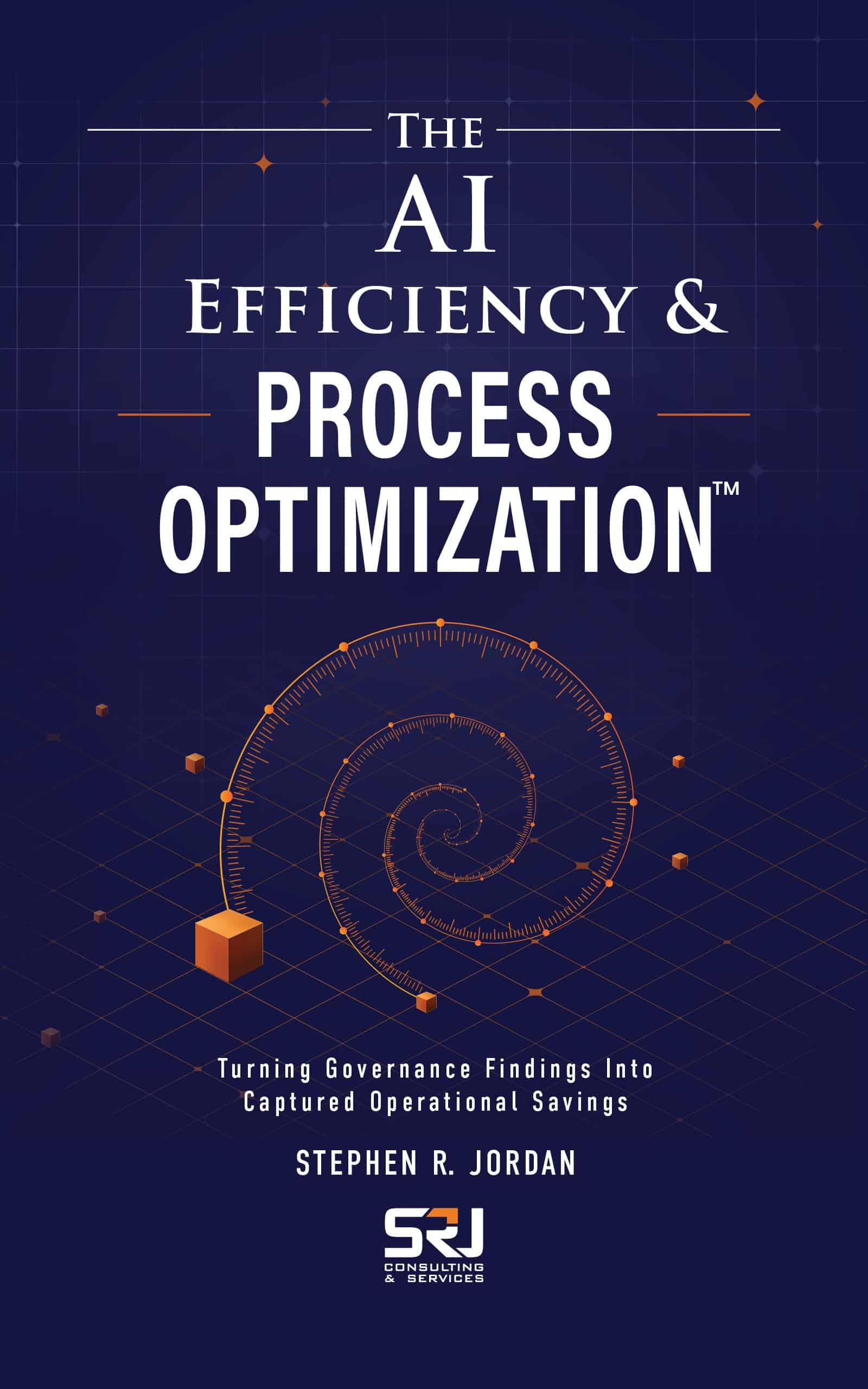
The AI Efficiency & Process Optimization™
How Leadership Teams Convert AI Adoption Into Measurable Operating Performance and a Defensible Financial Return
Available NowThe performance discipline that closes Pillar I. A structured operating discipline for converting AI adoption into measurable operating performance and a defensible financial return. Names the AI Efficiency Gap, maps Phantom Productivity, calculates the AI Efficiency Tax, and installs the Workflow Reality Map, the AI Process Fit Test, and the Four AI Performance Indicators. Produces a single AI Efficiency Scorecard, an AI ROI Formula the CFO can defend in the boardroom, an Executive AI Efficiency Brief the chair can read in five minutes, and a 90 Day AI Process Optimization Plan that runs inside the operating rhythm already in place.
Hardback, 368 pages, $89.99, ISBN 979-8-9965658-9-4. Paperback, $44.99, ISBN 979-8-9969402-1-9. Kindle edition, $24.99, ISBN 979-8-9969402-0-2.
What every Librarian needs to know about this book!
Volume IV of The Operating Discipline for AI Library™ · 368 pages · Hardcover ISBN 979-8-9965658-9-4. The library sell sheet fits on one page and carries the full bibliographic record, ISBNs and list prices for every format, Library of Congress and Dewey classification, a summary of what is inside, and the collections the book suits.
The executive briefing, in one page at a time.
A condensed visual companion to Volume IV. The four operating pillars, the named instruments, the board and CFO stress test, and the operating discipline executives use to convert AI adoption into measurable performance. Built for board distribution and leadership team review.
The AI Efficiency & Process Optimization™ is the discipline every leadership team is now being asked to demonstrate, and the one most are not yet equipped to defend.
The pain AI Efficiency & Process Optimization is built to address
The licenses are paid. The training is done. The pilots are everywhere. Twelve to eighteen months in, the recurring AI spend is real and the operating performance has not moved. Margins have not improved. Cost per customer has not dropped. Capacity has not expanded. What did show up is a recurring software bill, a quiet supervision overhead the senior reviewer is absorbing inside billable time, a rework loop nobody planned for, and a board asking sharper questions every quarter.
The book is written for the leader who has spent the money, told the team AI was going to change the business, pushed through the friction of adoption, and now has to answer the question that has arrived in every leadership room. Not what tools are being used. Not how many employees have logged in. The real question: what has AI actually done for this business?
Most leaders do not have a clean answer to that question right now. The gap between what AI appears to be doing and what it is actually doing to the P&L is what The AI Efficiency & Process Optimization is built to close.
The question has moved from adoption to proof
Four stakeholders have arrived at the AI conversation, and they are asking different versions of the same question.
The CFO: what did AI return after cost. The board: what moved, and who owns it. The lender: did AI improve cash flow stability. The acquirer: is AI scalable, documented, and defensible. None of those questions are answered by an adoption metric or a usage report.
The new executive standard is straightforward. Show what AI has moved, not simply where AI is being used. Volume IV is how that standard gets met by a leadership team running with the resources it already has.
What The AI Efficiency & Process Optimization book is
Volume IV is an operational execution book for the leader accountable for AI results, not just AI activity. The difference between those two things is larger than it sounds. AI activity is easy to generate. A dashboard fills with usage statistics, output volumes, and adoption rates in a matter of weeks. AI results are harder. They require workflow mapping, baseline measurement, structured testing, and a clear line connecting what AI did to what the business saved, gained, or improved.
The book does not require a Big Four firm, a Chief AI Officer, or a dedicated analytics department. It requires the same operating discipline a leadership team already applies to finance, hiring, and customer obligations, and it gives that discipline the structure to produce the financial answer the business now needs to have ready.
Every chapter connects AI to the P&L. Every tool is built for a small or mid-sized business with a real budget and a lean team. Every framework is designed to produce something you can walk into a room with and defend, not just something you can read and feel good about.
What you will learn from AI Efficiency & Process Optimization
How to map the workflows AI is already touching. How to identify where it is creating real efficiency and where it is creating the appearance of efficiency. How to measure cycle time, capacity, error rates, and labor savings with numbers you can stand behind. How to calculate an AI return on investment that holds up under CFO scrutiny.
The book introduces and develops the named operating instruments leadership teams use to close the AI Efficiency Gap: the Workflow Reality Map, the AI Process Fit Test, the AI Efficiency Tax estimate, the AI Efficiency Scorecard, the AI ROI Formula, the Executive AI Efficiency Brief, and the 90 Day AI Process Optimization Plan. Each instrument carries a worked example and a usable template.
The lesson that runs through every chapter is the same. AI activity is not AI efficiency. Usage is not improvement. Adoption is not optimization. A business that cannot measure what AI has moved is still managing a story rather than a result.
Who AI Efficiency & Process Optimization is written for
The book is written for executives and operating leaders, not engineers. The goal is measurable performance, defensible ROI, and a cadence the business can actually run.
The roles include owners and presidents, CEOs, CFOs, and COOs, managing partners, board members and operating partners, lenders, investors, and acquirers, and consultants advising mid-market clients. The sectors include professional services, accounting, legal, construction, manufacturing, distribution, healthcare, insurance, and financial services.
If you are responsible for the P&L, accountable for operating performance, or in a position where someone is going to ask you to justify your AI investment, the book is for you.
How to use AI Efficiency & Process Optimization in your business
Read it with your current AI Tool Inventory, your readiness decisions from Volume II, your governance records from Volume III, and your top three AI-supported workflows in front of you. Each chapter is designed to help you test one part of your AI operation, document what you find, and convert that finding into a decision your leadership team can act on.
The tools in the book are not meant to be read and set aside. They are meant to be used, filled in, and brought into your next leadership meeting. The fourteen-instrument Consulting Toolkit accompanying the book provides every artifact as an editable file.
If you have not completed the earlier Volumes, the book still works. You will need to do some foundational mapping as you move through the early chapters, and the book will guide you through that.
The case continuity across the Library
Readers who recognize the seventy-five-person construction firm, the forty-person accounting firm, and the sixty-person professional services practice from earlier Volumes will see them again here. The case patterns are continuations of the same operating realities those businesses face as AI work moves from visibility (Volume I) to readiness (Volume II) to governance (Volume III) to optimization (this Volume).
Each composite is drawn from patterns observed across many consulting engagements spanning more than two decades of professional practice. No single composite represents a single real engagement. Every composite combines elements from multiple distinct situations, and the specific numeric details are illustrative constructions designed to convey operating patterns in concrete terms.
What is inside AI Efficiency & Process Optimization, chapter by chapter
Chapter 1 names the AI Efficiency Gap and shows where it lives inside a business. Chapter 2 names Phantom Productivity, the most common specific pattern through which the gap appears. Chapter 3 puts a dollar figure on the AI Efficiency Tax. Chapter 4 introduces the Workflow Reality Map, which finds the cost at the step where it enters the process. Chapter 5 introduces the AI Process Fit Test, which turns the map into a decision: expand, refine, pause, or remove. Chapter 6 develops the four AI performance indicators that prove AI moved the operation. Chapter 7 builds the AI Efficiency Scorecard, a single operating view across every active use case. Chapter 8 builds the AI ROI Formula, the defensible number a CFO, board, lender, or acquirer can examine without it falling apart. Chapter 9 develops the Executive AI Efficiency Brief, a one-page communication format that replaces the AI enthusiasm update with an AI performance report. Chapter 10 installs the 90 Day AI Process Optimization Plan, a sequenced execution plan that runs inside the existing operating rhythm.
Where AI Efficiency & Process Optimization sits in The Operating Discipline for AI Library™
Volume IV is the closing book of Pillar I, AI Business Services™. The four Volumes in Pillar I sequence the operating disciplines a business needs to install AI honestly: visibility (Volume I), readiness (Volume II), governance (Volume III), and optimization (this Volume). Volumes I, II, and III build the foundation that makes AI defensible. Volume IV builds the layer that makes AI valuable. A business that finishes Pillar I has both.
Pillar II, AI Risk Governance & Security™, runs in parallel and addresses the security side of the AI Operating System™ through five further Volumes. The two pillars are deliberately independent.
How the book and the AI Efficiency & Process Optimization engagement work together
The book is the methodology, written for leadership teams that want to run the discipline themselves. The AI Efficiency & Process Optimization engagement is the execution, designed for leadership teams that want the artifacts produced, scored, and pressure-tested against their own data and their own workflows in ninety days.
Both share the same underlying operating instruments. The choice is whether to read, draft, and refine internally over six months, or to bring the firm in and have the artifacts on the table in ninety days. Aligning with the NIST AI Risk Management Framework and ISO/IEC 42001 does not, by itself, produce these answers. Those frameworks define the measurement obligations. The book is the operating discipline that meets them inside a real business, with a real cost base and a lean team.
Free downloads for this book
The worksheets and templates that ship with this book are free. Enter your email once, click the confirmation link we send you, and every book's downloads unlock across the site, forever.
Every consulting toolkit instrument, editable and ready to use.
The full Consulting Toolkit from the Appendix of the book. Fourteen instruments, each editable and ready to use. XLSX for the calculators, scorecards, and worksheets that run live formulas. DOCX for the same instruments in editable document form, sized for executive review and team distribution. Works in Excel, Google Sheets, Numbers, LibreOffice Calc, Microsoft Word, Google Docs, Apple Pages, and LibreOffice Writer.
Visual frameworks, ready for your presentations.
Every diagram, framework, and chart from the book is available here as an individual file. Use them in your slide decks, internal memos, board presentations, or training sessions. Free to use within your organization. Browse by chapter, click any image to download.


Explore the full book series.
The Operating Discipline for AI Library™ is the nine-book series across two pillars — AI Business Services™ (four books) and AI Risk Governance & Security™ (five books) — each mapped to one of the nine SRJ service lines. Browse the series, or speak with us directly about applying the framework in your organization.
Publication details
| Edition | ISBN-13 | List price |
|---|---|---|
| Hardcover | 979-8-9965658-9-4 | $89.99 |
| Paperback | 979-8-9969402-1-9 | $44.99 |
| Kindle | 979-8-9969402-0-2 | $24.99 |
Buy on Amazon List prices shown. Retailer pricing varies.