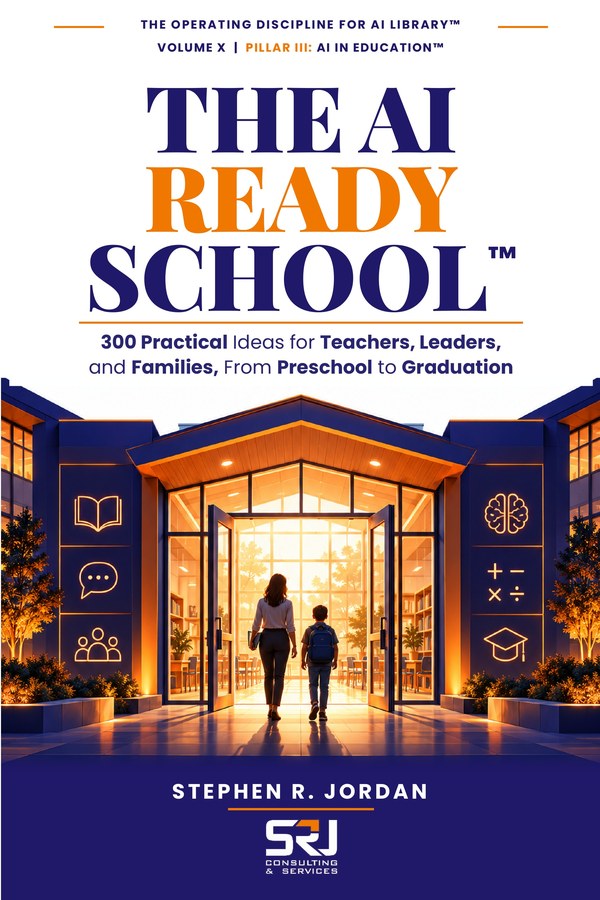
The AI Ready School™
300 Practical Ideas for Teachers, Leaders, and Families, From Preschool to Graduation
Available nowGet it on Amazon, Kindle $24.99, paperback $46.99, hardback $109.99. 338 pages, published November 2026. Book 10 of 10 in The Operating Discipline for AI Library™, and Volume X, the first Volume of Pillar III, AI in Education™. The first two Pillars answered the questions businesses ask about AI. Schools face all of those questions and one more: they are responsible for what AI does to how children learn, and for protecting children while it happens. This Volume gathers 300 practical ideas across 20 chapters, from preschool through graduation and from the classroom to the business office, each carrying an honest evidence label, held together by five rules that run through every chapter. Written for teachers, principals and district leaders, school board members, and parents. Every figure from the book, 134 in all, is available below, free to download and use within your school or district.
Hardback, 338 pages, $109.99, ISBN 979-8-9981369-9-3. Paperback, $46.99, ISBN 979-8-9981369-7-9. Kindle edition, $24.99, ISBN 979-8-9981369-8-6.
What every Librarian needs to know about this book!
Volume X of The Operating Discipline for AI Library™ · 338 pages · Hardcover ISBN 979-8-9981369-9-3. The library sell sheet fits on one page and carries the full bibliographic record, ISBNs and list prices for every format, Library of Congress and Dewey classification, a summary of what is inside, and the collections the book suits.
The executive briefing, in one page at a time.
A condensed visual companion to the Volume. The same tool and two opposite results, the five rules that run through every chapter, the evidence labels, and the first ninety days for a superintendent, a principal, a teacher, and a parent. Built for board distribution and leadership team review.
The same tool. Two opposite results.
In a trial with nearly 1,000 high school students in Turkey, students who practiced math with a plain chatbot saw their practice scores rise, then scored 17 percent worse on a later exam taken without AI. Most of them had asked for answers and copied them, and they did not believe copying had hurt them (Bastani et al., 2025). Less than a year later, students in Nigeria used a similar tool for six weeks. Their teachers wrote the opening prompt for each session so the tool acted as a tutor, and the teachers stayed in the room. Those students gained 0.31 standard deviations, one of the larger effects measured for a program that short (De Simone et al., 2025).
The technology was much the same. The difference was how adults designed its use, what the tool was allowed to do, and whether a teacher was present. AI in schools can help students learn or keep them from learning, and the outcome depends on choices that teachers, leaders, and families make. This Volume is about those choices.
Guidance tells schools what to avoid. It says much less about what works.
AI arrived in schools faster than almost any technology before it. Students found free chat tools before most districts had a policy, teachers began using AI to plan lessons before anyone trained them, and vendors added AI features to products schools already owned. As of June 2026, between 35 and 37 states plus Puerto Rico had issued guidance on AI in schools, and Ohio required every district to adopt an AI policy by July 1, 2026. Guidance and rules tell schools what they must avoid. Teachers and leaders also need to know which uses of AI help students learn, which ones save staff time, and which ones cause harm. That is the gap this Volume fills.
300 practical ideas, each with an honest evidence label.
The Volume gathers 300 ideas across 20 chapters, from preschool through graduation and from the classroom to the business office. Every idea carries an evidence label: 17 are Strong, 27 Moderate, 28 Emerging, and 228 Practice. The labels are honest about how young this field is, and they tell readers how much weight each idea can bear.
It is equally direct about what does not work or is not yet known. AI detectors misclassify writing by students still learning English, so a detection score must never be treated as proof. No evidence shows that online monitoring of students prevents harm, and the research gathered for this Volume found no independent evaluation of AI security systems in schools. Research on young children and on students with disabilities is thin, and the Volume says so wherever it matters.
Five rules that run through every chapter
- People make every decision that affects a student, because research shows that when a machine decides first, people rarely correct it.
- Student names and details stay out of any tool without a signed data privacy agreement.
- Tools that help students learn give hints rather than answers.
- Every AI draft is checked by a person before it is used.
- Every flag a system raises leads to a person who reaches out.
Four parts. From first principles to running the school.
Part I, Getting Oriented, explains what AI can and cannot do, ten patterns that show up everywhere, privacy and the human review rule, and how to pilot, measure, and scale. Part II, The Classroom, works subject by subject from preschool through twelfth grade: reading and writing, mathematics, science and computer science, social studies and world languages, the arts and physical education, and personalized tutoring. Part III, Every Student, Every Family, covers special education and accessibility, English learners and newcomers, communicating with families, wellbeing and attendance, and counseling, college, and career. Part IV, Running the School, covers teacher planning and grading, assessment and early warning systems, operations and finance, and people, leadership, and culture.
Some of the strongest findings involve no classroom at all
Weekly messages to families about missed work, grades, and absences cut course failures by 27 percent in a randomized trial (Bergman & Chan, 2021), and plain, supportive notices outperformed legal language (Lasky-Fink et al., 2021). Personal reminders from a student’s own counselor helped students reach college, while national campaigns that reached hundreds of thousands of students had no effect (Bird et al., 2021). Relationships carried the results, and technology carried the relationships.
Written for the people who decide on Monday morning.
Teachers will find practical ideas for planning, teaching, feedback, and grading, organized by subject and grade. Principals and district leaders will find guidance on policy, pilots, purchasing, and professional learning. School board members will find the questions they should ask and the evidence they should expect. Parents will find sections that speak directly to families, including five questions every parent should be able to ask a school, and the answers a good school gives. No technical background is needed.
Every chapter opens with outcomes and closes with the question a board should ask, the evidence needed to answer it, the failure pattern that trips districts up, and a Thirty Day Move any school can take. The final chapter lays out the first 90 days for a superintendent, a principal, a teacher, and a parent. None of those steps requires buying anything.
Tools do not change schools. The people in them do.
AI adoption fails when leaders mandate tools they do not use, reward logins instead of results, and skip the rules. It succeeds when leaders model use, measure hours saved and student outcomes, and publish the rules for privacy, review, and accountability.
Where this Volume sits in the Library
The first two Pillars of The Operating Discipline for AI Library™ answered the questions businesses ask about AI: what is in use, what it costs, whether it is governed, and whether it is secure. Schools face all of those questions and one more. A school does not only use AI to run its operations. It is responsible for what AI does to how children learn. Volume X opens Pillar III, AI in Education™, to answer that question. For districts that want an independent check of their own schools, The AI Ready School™ Audit applies the Volume in practice.
Free downloads for this book
Every figure from this book is free. Enter your email once, click the confirmation link we send you, and every book's downloads unlock across the site, forever.
Visual frameworks, ready for your staff meetings.
Every figure from the book, 134 in all, is available here as an individual file. Use them in staff training, board presentations, family nights, or planning sessions. Free to use within your school or district. Browse by chapter, click any image to download.


Publication details
| Edition | ISBN-13 | List price |
|---|---|---|
| Hardcover | 979-8-9981369-9-3 | $109.99 |
| Paperback | 979-8-9981369-7-9 | $46.99 |
| Kindle | 979-8-9981369-8-6 | $24.99 |
Buy on Amazon List prices shown. Retailer pricing varies.