AI Governance Update: The Week the Rules Arrived
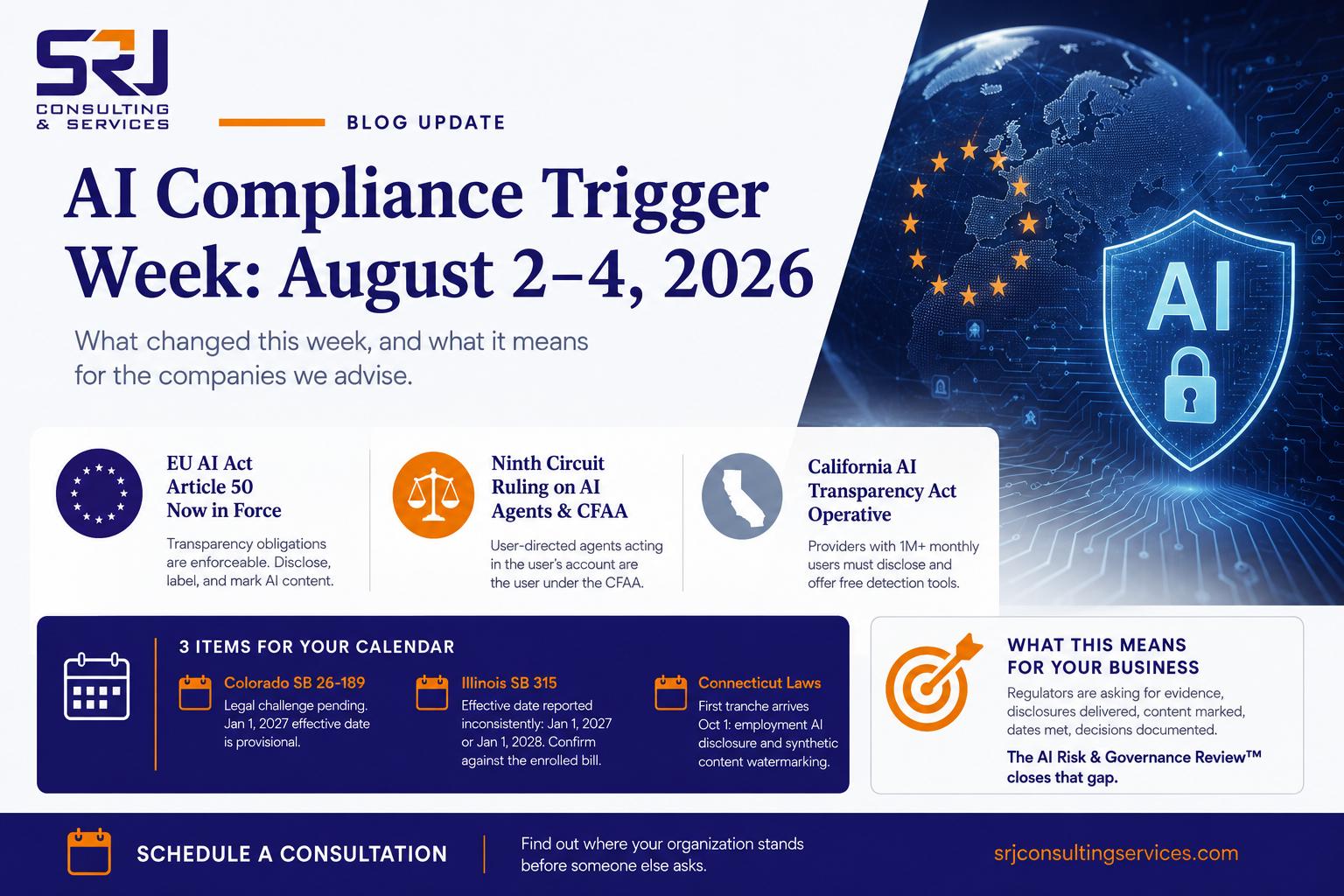
This AI governance update covers August 1–7, 2026, the most consequential compliance week of the year so far. Three things changed: the EU AI Act's Article 50 transparency obligations became enforceable on August 2, California's AI Transparency Act went operative the same day, and on August 4 the Ninth Circuit issued the first federal appellate ruling on AI agents under the Computer Fraud and Abuse Act. If your company runs a chatbot, ships generative AI, or deploys AI agents, at least one of these now applies to you.
Last updated: August 7, 2026
This week's AI governance update at a glance
The short version, for the executive who has ninety seconds. AI transparency obligations are now enforceable on two continents as of the same day, August 2, 2026. In the EU, chatbots must disclose that they are AI, synthetic content must carry machine-readable marking, and deepfakes must be labeled, with fines up to 15 million euros or 3 percent of worldwide turnover. In California, generative AI providers with more than one million monthly users must offer a free AI detection tool and disclose AI-generated content. And in the courts, AI agents acting on user instructions received their first favorable federal appellate precedent. The rest of this AI governance update takes each in turn.
EU AI Act Article 50: the AI governance deadline that arrived
The waiting is over. As of August 2, any company whose chatbot, generative AI tool, or synthetic media product reaches EU users must disclose that users are interacting with AI, mark AI-generated content in machine-readable form, and label deepfakes. The European Commission confirmed that enforcement has begun through national market surveillance authorities, and roughly 190 organizations had signed the voluntary Code of Practice on Transparency of AI-Generated Content by the enforcement date.
One narrow grace period survives. Generative AI systems already on the market before August 2 have until December 2, 2026 to meet the machine-readable marking obligation. Everything else applies now, and headquarters location is irrelevant: a single EU user of your product puts you in scope. Signing the Code of Practice is now a strategic AI governance decision in its own right, because signatories benefit from a presumption of conformity while non-signatories must demonstrate compliance by other means under closer scrutiny. Our EU AI Act reference page carries the full timeline, the high-risk deferrals, and the compliance path.
AI governance in the courts: the Ninth Circuit on AI agents
On August 4, the Ninth Circuit vacated the injunction that had blocked Perplexity's Comet browser agent from shopping Amazon on behalf of its users. The court held that when a user directs an AI agent to act for them, in their own account, with their own credentials, it is the user who accesses the website under the CFAA, not the AI company.
It is a favorable precedent for anyone building or procuring AI agents that transact on third-party platforms, and a deliberately narrow one. It decides only the CFAA access element for user-directed agents. Terms-of-service claims, trademark claims, and the treatment of fully autonomous agents all remain open, and Amazon's surviving claims head back to the district court, where the practical limits of the ruling will be drawn. The operational lesson for any AI governance program deploying agents: keep the human instruction at the front of the chain, keep the agent inside the user's own accounts, and document both. We have published a full analysis on our new reference page, Agentic AI and the CFAA.
California's AI governance trigger: SB 942 went operative
The California AI Transparency Act became operative on August 2, the same day as Brussels. Generative AI providers with more than one million monthly users must now offer a free AI detection tool and disclose when content is AI-generated.
If your platform clears that threshold, the efficient move is one cross-jurisdictional review covering the California and EU obligations together, because the requirements overlap, the evidence overlaps, and the deadline was the same day. Running two separate compliance projects for one disclosure surface is how AI governance budgets get spent twice. Details are on our California AI Laws reference page.
Three AI governance dates for the calendar
Colorado, provisional. Colorado's replacement AI law, SB 26-189, faces a pending legal challenge, so treat its January 1, 2027 effective date as provisional until the litigation resolves. Companies that built compliance programs around the original Colorado AI Act should reassess either way, because the replacement framework is materially narrower for most enterprise deployers.
Illinois, verify before you commit. The effective date of Illinois SB 315, the frontier AI safety law signed July 6, is reported inconsistently: January 1, 2027 in pre-signing analyses and January 1, 2028 in day-of-signing coverage. Confirm against the enrolled bill text before committing compliance dates to a board deck.
Connecticut, 54 days. The first tranche of Connecticut's SB 5 takes effect October 1, 2026: employment AI disclosure and synthetic content watermarking. If you employ people in Connecticut and use AI anywhere in hiring, promotion, or discipline decisions, the readiness work belongs on this month's agenda, not next month's.
Washington, watch the FTC. The comment period on the FTC's proposed AI accuracy policy statement closed July 31 with roughly forty comments filed, including a direct challenge to the agency's authority to preempt state AI laws. No final policy has issued. If it is adopted as proposed, the preemption question will reshape the compliance posture for Colorado, Illinois, and every other state AI regime on this list, which makes it the quietest item this week and potentially the largest.
What this AI governance update means for your business
The pattern across every item this week is the same. Regulators are no longer asking whether you have AI principles. They are asking for evidence: disclosures delivered, content marked, detection tools live, dates met, decisions documented. A principles page does not survive that conversation. A dated record does.
That is exactly the gap The AI Risk & Governance Review™ closes: a structured review of what AI is running, which regimes reach it, and whether the evidence a regulator, insurer, or enterprise customer would ask for actually exists. Schedule a consultation to find out where your organization stands before someone else asks.
How SRJ tracks AI governance weekly
This post is drawn from the SRJ AI Governance Weekly Watch, the standing research cycle behind our AI Governance Reference Library. Every week we sweep the regulators, the courts, the state legislatures, and the standards bodies, update the reference pages the same day, and publish the developments that change what our clients must do. The library covers more than sixty regimes and frameworks, each maintained against primary sources. When the rules move, the pages move with them.