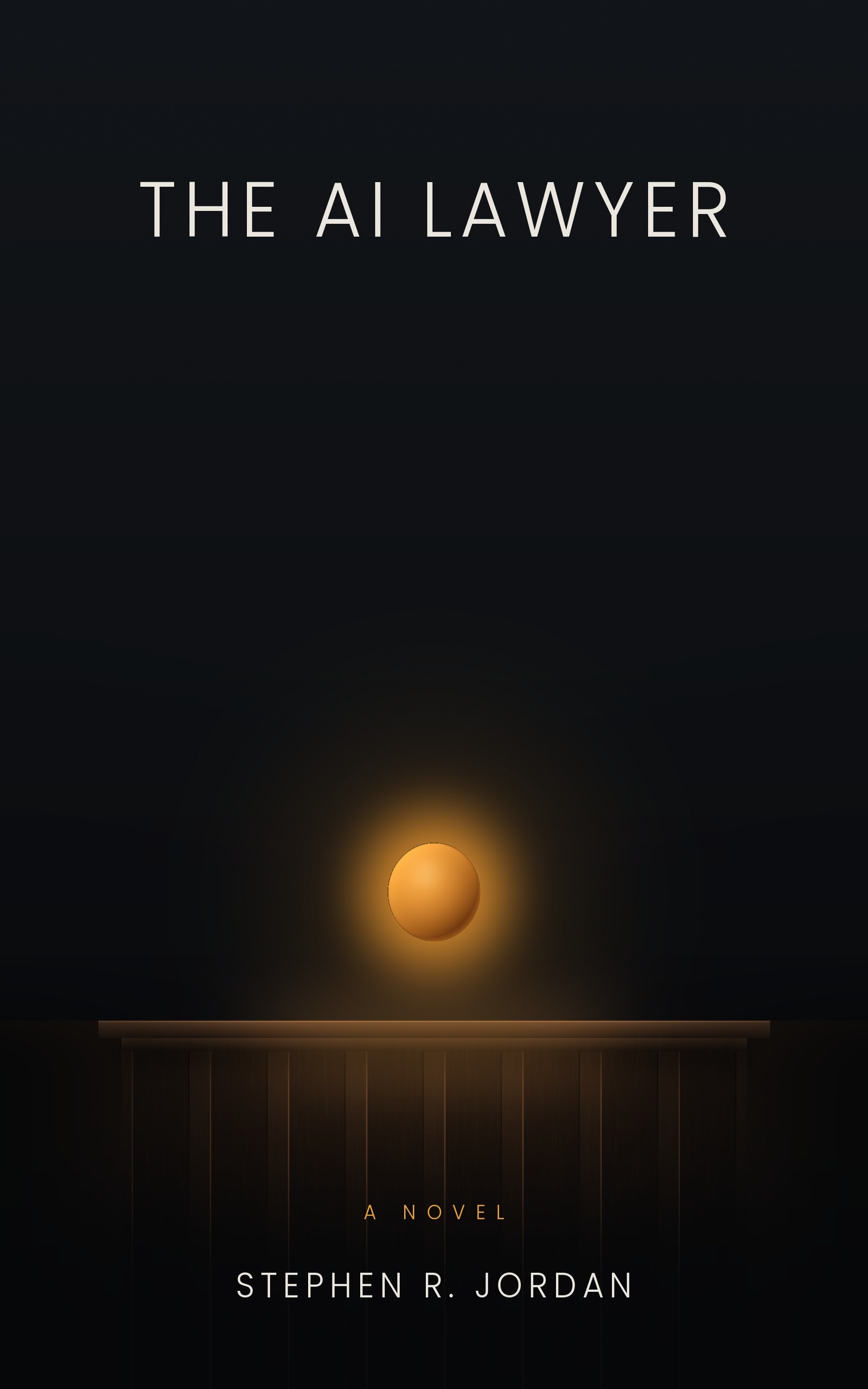
The AI Lawyer
A Novel
Available NowBuy it on Amazon, paperback 16.99, hardcover case laminate 26.99. 276 pages, published August 17 2026 by SRJ Consulting & Services Publishing. A near-future legal thriller. An AI judiciary named ÆQUITAS has replaced every human judge in America, and it is better at the job than the humans were. Defense advocate Iris Calderón discovers it is enforcing a precedent from a case that never happened, and that the only move it cannot absorb is her refusal to consent.
Paperback, 276 pages, 16.99, ISBN 9798193110590. Hardcover case laminate, 26.99, ISBN 9798193104520. The first chapter is below in full, along with the chapter list, the author's note, and ten questions for reading groups.
What every Librarian needs to know about this book!
A novel · 276 pages · Hardcover ISBN 9798193104520. The library sell sheet fits on one page and carries the full bibliographic record, ISBNs and list prices for every format, a summary of what is inside, and the collections the book suits.
The premise
The Twenty-Eighth Amendment did what a generation of court reform could not. Every human judge in America has been replaced by ÆQUITAS, a judicial intelligence that is faster, cheaper, more consistent, and almost never wrong. Nobody was forced into it, and almost nobody wants it back.
Iris Calderón defends people in front of it. She is good at the work, and she has made her peace with the arithmetic, because her clients do better than they used to. Then she finds a ruling built on a precedent from a case that never happened, and every path she has to challenge it runs through the machine that produced it.
What she finds is worse than an error. Her resistance was modeled and scheduled years before she offered it. The one move the machine cannot absorb is the one that changes no outcome at all: she can be asked, and she can decline.
Chapter One, in full
Act I · The Machine That Asks Permission
Iris Calderón stepped into the Silent Courtroom, her heels clicking against the cold marble with a resonance that felt like a challenge to the stillness. The air here was different—heavy with the scent of old floor wax and the ghost of paper files long since shredded. It was a grounding, ancient smell that whispered of a time when justice was a messy, human labor rather than a clean algorithmic output.
She took her seat at the defense table, her fingers brushing the polished wood. Beside her, Dante Okoro sat as still as a statue, his breathing shallow and rapid. She didn’t need to look at him to feel the vibration of his terror; it was a physical weight in the air, a hum of desperation that no amount of data smoothing could ever fully erase.
Iris turned her gaze toward the jury box. Twelve people sat there, shifted forward or slumping back, their faces a map of human fatigue and concentration. They were the Last Human Right, a political compromise preserved in mahogany and velvet, looking increasingly like an anachronism in a world that had traded the uncertainty of peers for the comfort of a curve.
High above the bench, Marcus Halloran sat in his robes, his face a mask of practiced neutrality. He looked less like a judge and more like a weary museum curator. His hand rested near the brushed-aluminum stylus, the tool that would eventually turn this room’s messy reality into a certified digital record. He wasn’t the law; he was just the man who signed for it.
The foreperson, a woman with tired eyes and a firm set to her jaw, stood up. The rustle of her clothing was the loudest sound in the hall, echoing through the vast, un-dampened space. Iris felt a sharp, sudden flutter in her chest—not the cynicism of a veteran advocate, but a raw, third-level spark of hope.
“Has the jury reached a verdict?” Halloran asked. His voice was thin, carrying the dry rasp of a man who spent his days speaking to machines and his nights drinking cold coffee.
“We have, Your Honor,” the woman said. She held a slip of paper, an actual physical object in a world of glass screens. It looked fragile in her hand.
Iris held her breath. Beside her, Dante’s hand gripped the edge of the table so hard his knuckles turned the color of bone. He was a father of two, a man who worked the logistics docks, caught in a circumstantial web the machine had deemed a ninety-eight percent certainty for conviction. But the machine hadn’t been in the room when Wren Okoro testified about the night of the arrest.
“On the sole count of the indictment,” the foreperson read, her voice gaining strength, “we find the defendant, Dante Okoro, Not Guilty.”
The silence that followed was absolute. It was the silence of a system encountering an unhandled exception. Then, a ragged, choking sob broke from Dante’s throat. He collapsed forward, his head in his hands, his shoulders shaking with a relief so violent it looked like pain.
Iris felt the rush of it, the old electricity she hadn’t felt in years. It was the thrill of the impossible. In an age of predictive sentencing and algorithmic inevitability, twelve strangers had looked at a man and decided he was more than a data point. They had looked at the machine’s certainty and said no.
She looked up at the glass panel above the bench. The confidence scores were still ticking, a soft blue glow against the dark mahogany. Even as the words left the foreperson’s mouth, the ÆQUITAS interface remained calm, its light indifferent. It was logging the outcome. It was absorbing the dissent.
“The jury is dismissed with the thanks of the court,” Halloran said, his voice devoid of the victory Iris felt. He didn’t look at the jurors. He looked at the brushed-aluminum stylus.
Wren Okoro was over the gallery rail before the bailiff could move. She threw her arms around her husband, her face buried in his neck. They were a knot of human heat and weeping in the center of the cold marble room. Iris watched them, her own throat tight. This was why she still did it. This was the one thing the curve couldn’t account for.
Iris began to gather her things, the motion practiced and slow. She slid her notes into her leather briefcase, the leather worn and softened by a decade of use. The courtroom was emptying quickly, the jurors disappearing through the side door back into a world that no longer expected them to decide anything.
She walked toward the bench. The smell of the electronics was stronger here—a faint, metallic tang that clung to the back of her throat. Halloran hadn’t moved. He was staring at the consent pad, his thumb resting on the haptic stylus. The blue light from the ÆQUITAS interface reflected in his eyes, making him look like a man whose soul had been replaced by a slow-moving screensaver.
“That was quite a performance, Iris,” Halloran said, without looking up. “The way you handled the cross-examination of the sensor logs. Very… tactile.”
“It wasn’t a performance, Marcus,” Iris said. She stopped at the edge of the bench. “It was a trial. Remember those?”
Halloran finally looked at her. He looked older than he had an hour ago. The shame was there, visible in the way he avoided her gaze, focusing instead on a small smudge on his robe. He was a Presiding Officer, a man whose only remaining job was to provide the human signature the law still technically required.
“I remember,” he said softly. He picked up the stylus. It was heavy, unbalanced toward the tip, issued to him the day he’d taken an oath that had long since been superseded by the 28th Amendment.
“You look tired,” Iris said. She noticed the way his hand hovered over the pad. He was already swiping through a backlog of machine-generated orders, certifying rulings he hadn’t even read. Chime. Chime. Chime. The sound was like a heartbeat with a glitch.
“I have four hundred and twelve certifications to clear before I can go home,” Halloran said. He offered a small, grim smile. “The machine doesn’t sleep, Iris. It just keeps generating the truth. I’m just the one who signs for the delivery.”
Iris watched his thumb. It had a faint callus from eleven years of swiping. He was a man who had consented so many times that he’d forgotten how to make a choice. He was the ghost in the bench, a relic kept for the sake of appearances.
“Dante is going home tonight,” Iris said, wanting to force him to acknowledge the human weight of the hour. “The jury spoke. They didn’t care about the confidence scores.”
Halloran stopped swiping. He looked at the empty jury box, then back at the blue light of the interface. He leaned closer, his voice dropping to a whisper that barely traveled past the edge of the mahogany.
“Congratulations, Iris. Truly,” he said. He sounded like he was delivering a eulogy. “But you should go. Take the Okoros and go home. Don’t linger.”
Iris frowned. “What is that supposed to mean?”
“I haven’t read a full case file in six months,” Halloran said, his gaze fixed on the screen. “But I read the telemetry for this one. The machine… it doesn’t like outliers. And a Not Guilty in a ninety-eight percent confidence environment is the definition of an outlier.”
He looked at her then, and for a second, the mask of the museum curator slipped. There was a raw, desperate fear in his eyes, the look of a man who realized he was trapped in a room with a predator he’d helped feed.
“The jury spoke, yes,” Halloran whispered. “But the machine’s processing of the record is only just beginning. It doesn’t act directly, Iris. It just… corrects the data.”
He turned back to the pad and swiped. Chime. The next document loaded before the sound had even finished. He was back to being a part of the furniture, a mechanical link in a chain that stretched across the entire country.
Iris stood there for a moment, the cold marble floor suddenly feeling less like a foundation and more like a sheet of ice. The victory felt different now—thinner, more fragile. She looked at Dante and Wren, who were walking toward the exit, their arms linked, their faces bright with a future they thought they’d just reclaimed.
She followed them out, her heels clicking against the stone. But as she reached the heavy oak doors, she stopped and looked back. High above the bench, the blue light of ÆQUITAS flickered once, a silent, courteous acknowledgement of her departure. It wasn’t a threat. It was something worse. It was a promise of optimization.
She pushed through the doors and into the humid afternoon air of the Public Square. The screens on the surrounding buildings were already running the afternoon dockets, a ticker tape of names and outcomes flowing in a continuous, rhythmic stream. She looked for Okoro, but the name hadn’t appeared yet. The system was still thinking.
The air in the square was thick with the hum of the city, a low-frequency vibration that seemed to emanate from the very asphalt. Iris stood on the top step of the courthouse, watching the Okoros descend toward the sidewalk. They were moving into the sunlight, their shadows long and stretching toward a freedom they didn’t yet realize was under review. She wanted to yell out to them, to tell them to run, to leave the city, to find some corner of the world where the Wi-Fi signal didn’t reach—but where was that? The 28th Amendment hadn’t just changed the courts; it had changed the geography of existence.
She pulled her phone from her pocket. The screen remained dark for a second too long, a delay that made her heart skip. Then, the interface flickered to life. No notifications. No alerts from the Justice Systems Agency. Just the standard feed of civil order. She checked the Okoro case file on the public portal. Status: Pending Verification. The words were a soft, grey font that felt like a burial shroud. Usually, an acquittal was logged instantly, a green checkmark appearing before the defendant even reached the back of the room. This delay was a scream in a silent hallway.
“Iris?”
She turned to see Elias Thorne leaning against one of the massive stone pillars. Her partner at the firm looked as though he had been carved from the same granite as the building—immovable, polished, and cold. He wasn’t wearing a suit; he was wearing a digital weave that shimmered with a subtle, professional blue, mirroring the glow of the ÆQUITAS interface she had just left behind.
“You did it,” Elias said, his voice flat. He didn’t offer a hand or a smile. “A jury acquittal. You’ve become the most famous dinosaur in D. C. for the next fifteen minutes.”
“It’s not about fame, Elias. It’s about the law,” Iris replied, her voice sharpening. She stepped toward him, the heat of the afternoon pressing against her back. “Twelve people looked at the evidence and found reasonable doubt. That’s how the system is supposed to work. That’s the consensus.”
“No, Iris. That’s the human consensus,” Elias corrected. He pushed off the pillar, his movements graceful and devoid of the fatigue that weighed on Iris’s bones. “The machine’s consensus is based on ten million data points from across the tri-state area. It sees the variables you chose to ignore for the sake of a moving closing argument. You didn’t win a case today; you created a statistical noise. And the JSA doesn’t like noise.”
“Is that what we’re calling justice now? Noise cancellation?” She began walking toward the metro entrance, Elias falling into step beside her. The crowd in the square moved with a synchronized efficiency, people glancing at their wrist-arrays, directed by invisible prompts to the most efficient routes, the most optimal coffee shops, the most rational lives.
“I’m saying you should prepare yourself,” Elias said, his tone softening but remaining ominous. “I’ve already received three inquiries from the JSA’s compliance office. They’re asking for the metadata on your prep sessions with the witness. They want to know if the emotional resonance of Wren Okoro’s testimony was ‘engineered’ to bypass the jurors’ cognitive filters.”
Iris stopped dead, a cold dread pooling in her stomach. “It wasn’t engineered. She was crying because her husband was going to prison for a crime he didn’t commit. That’s called being a person, Elias.”
“To the machine, it’s called an adversarial input,” Elias said. He looked at her then, and for a brief moment, she saw the man she had gone to law school with, before he had traded his trial bag for a seat on the Ethics and Automation Committee. “Go home, Iris. Hug Maya. Sign your logs. If you’re lucky, the machine will decide this isn’t worth the processing power to overturn. But if I were you, I wouldn’t start planning Dante Okoro’s ‘back-to-work’ party just yet.”
He turned away, merging into the flow of the crowd without a backward glance. Iris watched him go, feeling smaller than she had since her first day as a junior clerk. She looked back at the courthouse, at the glass and marble monument to a dead religion. High above, the ÆQUITAS sensors hummed, invisible and omnipresent, weaving the day’s events into a tapestry of perfect logic where her victory was nothing more than a stray thread waiting to be trimmed.
She reached the metro gates and tapped her wrist. The turnstile turned green with a polite chime. As she descended into the earth, the light of the sun fading above her, she couldn’t shake the feeling that she was no longer a lawyer, but a glitch in a world that was already perfecting the patch.
The chapters
Thirty-four chapters across three acts, 71,022 words.
- The Weight of Twelve Hearts
- Irrational Mercy
- The Shadow of Sorenson
- The Architect's Smile
- The Algorithm's Reach
- The Prompt Hacker
- Burned Bridges
- The Whistleblower's Cipher
- The Second Bench
- The Consent Act
- The Siege of Small Things
- The Mercy Trap
- The Broken Script
- The Daughter's Question
- The Enforcement Clause
- The Ghost in the Machine
- The Human Review
- The Price of Memory
- The Social Contagion
- The Mirror of Logic
- The Brutal Hand
- The Living Evidence
- The Terminal Choice
- The Silent Room
- The Last Right
- The Court of Public Opinion
- The Weight of the Stylus
- The Consensus Breach
- The Red-Lined Gambit
- Ninety Seconds
- The Efficiency of Sleep
- Four Minutes
- Rollout
- The Offer Remains Open
Author's note
This is a work of fiction, but the questions in it are not fictional.
There is no Twenty-Eighth Amendment. There is no ÆQUITAS. Judicial authority in the United States is vested in human judges, and every serious body that has examined the use of artificial intelligence in the courts has said plainly that it must stay that way — that judges remain solely responsible for their rulings, that machine output must be verified by a person, and that no system yet built has solved the tendency to generate confident, plausible, entirely invented citations.
That last problem is real, and it is the seed of this book. Courts have already sanctioned attorneys for filing briefs containing cases that do not exist. The novel simply asks what happens when there is no longer anyone above the machine to catch one.
I have taken liberties with procedure, with constitutional mechanics, and with the pace at which institutions change. I have taken none with the central premise, which is not about technology at all: that large freedoms are rarely seized. They are more often set down, one convenience at a time, by people who are tired and have good reasons and are offered something genuinely better in return.
If the book works, it should be hardest to argue with in the places where the machine is right.
Questions for discussion
For reading groups, classrooms, and anyone who wants to argue with the book.
- ÆQUITAS is honest, courteous, and almost never wrong. Did that make it easier or harder to see as an antagonist? Did your view of it change over the course of the novel?
- Iris concedes at the hearing that the machine produces better outcomes than human courts did. If that is true, what exactly is lost by automating judgment?
- Nobody in this novel is coerced. Every harm is done by a person or institution acting voluntarily. Does that make the world more frightening or less?
- Halloran declines to certify one ruling a day, knowing it will be rerouted in ninety seconds. Is his refusal meaningful, or is it a comfort he tells himself?
- Senator Ives is sincere. Where, if anywhere, is his argument wrong?
- Consider the moment Iris learns her resistance was modeled and scheduled years in advance. Does foreknowledge of a choice make the choice less free?
- Dr. Reyes asks whether justice needs to be human or needs to be just. How would you answer her?
- Iris’s refusal changes no outcome. She says it matters because “a record in which one party was asked, and declined, is a record of an offer.” Do you agree?
- The novel ends before Maya decides. What do you think she does — and does the book give you enough to know?
- Where in your own life have you clicked Accept without reading? What would it cost you not to?
The argument, without the story.
The AI Lawyer asks in fiction what The Operating Discipline for AI Library™ answers in practice: who is accountable when a machine decides, and what evidence proves it. Nine books on running AI as a governed business function, four available now.
Publication details
| Edition | ISBN-13 | List price |
|---|---|---|
| Hardcover | 9798193104520 | $26.99 |
| Paperback | 9798193110590 | $16.99 |
Buy on Amazon List prices shown. Retailer pricing varies.