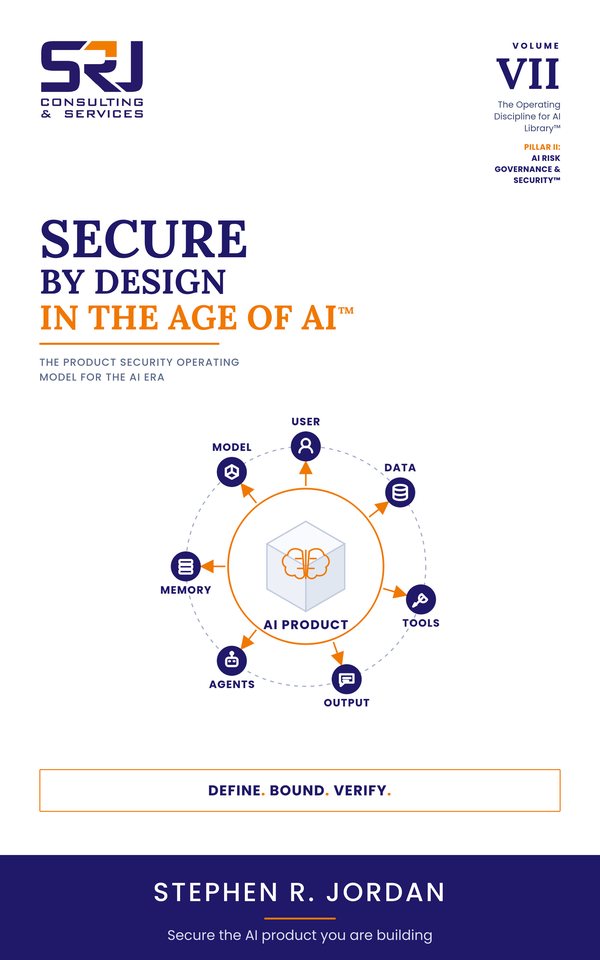
Secure by Design in the Age of AI™
The Product Security Operating Model for the AI Era
Available nowBook 07 of 9 in The Operating Discipline for AI Library™, Book 3 of 5 in AI Risk Governance & Security™. Secure by Design has changed from a compliance posture into a capacity problem. Engineering velocity has increased by an order of magnitude. Security review capacity has not. At the same time, AI introduces a class of vulnerabilities that traditional, deterministic tools are structurally unable to detect. This book introduces The Dual-Impedance Problem and provides the working frameworks executives need to ship AI-enabled products faster and more securely than the organizations they compete with. The complete set of figures from the book is available below, free to download and use within your organization, alongside the thirty-three operating instruments of the Consulting Toolkit, editable and ready to run.
Hardback, 444 pages, $109.99, ISBN 979-8-9969402-9-5. Paperback, $46.99, ISBN 979-8-9969402-8-8. Kindle edition, $24.99.
What every Librarian needs to know about this book!
Volume VII of The Operating Discipline for AI Library™ · 444 pages · Hardcover ISBN 979-8-9969402-9-5. The library sell sheet fits on one page and carries the full bibliographic record, ISBNs and list prices for every format, a summary of what is inside, and the collections the book suits.
The executive briefing, in one page at a time.
A condensed visual companion to the book. The Dual-Impedance Problem, the five frameworks that answer it, the gate-versus-verification distinction every customer and auditor now tests for, the Review Capacity Ratio, and the first ninety days sequenced by dependency. Twenty-six slides, built for the practitioner who owns the work and the leadership team that funds it.
AI has changed product security from a quality function into a capacity problem.
Two forces compound at once. Engineering velocity has increased by an order of magnitude while security review capacity has not, opening a widening gap between how fast products are built and how fast they can be reasonably secured. Layered on top of that velocity gap, AI introduces a fundamentally different class of risk: vulnerabilities that exist at the meaning layer, not the syntax layer, where deterministic tooling cannot reliably find them. Most organizations are quietly shipping AI-enabled products faster than they can secure them, and learning about the gap from customers, regulators, or breach disclosures.
This book names that combined condition The Dual-Impedance Problem and treats it as the strategic context every product organization now operates inside. Organizations that solve it use AI to close the security capacity gap and build structural boundaries around AI's new failure modes. Organizations that do not ship faster, accumulate undetected risk, and discover it from the outside.
Every gate was passed. The feature still did something nobody asked for.
The feature shipped on a Thursday. Nine days later a customer’s security team found it would apply a credit to an account it had never been asked about, and the director pulled the release record expecting to find the gate someone had gone around.
Every gate had been passed. The sprint had closed forty-one changes, thirty of them generated with an assistant, and the two reviews the lifecycle required had each taken about eleven minutes. Nothing was skipped. The review had been sized for a quarter, and the engineers now ship in a week.
What this book gives you
At its center are five frameworks, one question each: see the whole surface, sort before you design, verify at the rate the product changes, decide, then sustain. They install as working instruments rather than policy: The AI Attack Surface Ledger, one row for every boundary crossing in every product; The AI Feature Tier Map and the Seven Stop Conditions, which decide where scarce human judgment goes; The Two-Lane Assurance Model, which sends rate to the machine and kind to the human; and The Ship Decision Record and the Product Security Case, which produce release evidence rather than remediation evidence. Beside them sits The Review Capacity Ratio, the number that turns a backlog complaint into a decision a CFO can act on.
The frameworks are aligned with the CISA Secure by Design program, OWASP LLM Top 10, NIST SSDF, and emerging AI regulation. They produce decisions defensible to a board, an auditor, or a regulator, not a slide deck.
Who it's for
CISOs, CTOs, VPs of Engineering and Product, security architects, board members, and compliance officers in organizations shipping AI-enabled products to enterprise customers or regulated industries. No technical background required for the executive deliverables; engineering-grade depth available for the architects and senior engineers who will own the implementation.
The Consulting Toolkit
Thirty-three working instruments ship with the book as its appendix set, from the Defensible Product Security Baseline Scorecard and the Review Capacity Ratio Worksheet through the AI Attack Surface Ledger, the AI Feature Tier Map, the Lane Assignment Table, the Ship Decision Record, the Product Security Case, the Product Attestation Pack, and the Judgment Budget. Every figure behind them, and every framework diagram from all sixteen chapters, is in the Chapter Graphics Library below, free to download and use within your organization today.
How the book and the Secure by Design in the Age of AI engagement work together
The book is the operating manual, written for the product security leaders who will run the program themselves: the ledger, the tier map, the two lanes, the release gate, and the attestation pack, installed against their own release calendar. The Secure by Design in the Age of AI™ engagement is the execution of that model, designed for organizations that want the baseline scored, the ratio computed, the boundaries drawn, and the first ninety days sequenced inside a defined timeline, not learned, drafted, and refined over two quarters of internal effort.
Teams that want the discipline in book form work from the book. Teams that want the tier map drawn against their own products, the lanes staffed against their own review capacity, and the attestation pack assembled for their own customers, work directly with the firm.
Free downloads for this book
The worksheets and templates that ship with this book are free. Enter your email once, click the confirmation link we send you, and every book's downloads unlock across the site, forever.
Every operating instrument, editable and ready to run.
The thirty-three operating instruments from the book, free and editable, one for every item in the Appendix. These are the working material of the first ninety days and the operating year that follows, not reading material. The spreadsheets work in Microsoft Excel, Google Sheets, Apple Numbers, and LibreOffice Calc; the fill-in forms open in any word processor.
The program’s first artifact. Seven areas, scored on one product, dated and reviewed. Fill it in first: in an afternoon it tells you where the program actually stands, and it produces the baseline every later instrument reads.
Visual frameworks, ready for your presentations.
Every diagram, framework, and chart from the book is available here as an individual file. Use them in your slide decks, internal memos, board presentations, or training sessions. Free to use within your organization. Browse by chapter, click any image to download.


Publication details
| Edition | ISBN-13 | List price |
|---|---|---|
| Hardcover | 979-8-9969402-9-5 | $109.99 |
| Paperback | 979-8-9969402-8-8 | $46.99 |
| Kindle | 979-8-9981369-6-2 | $24.99 |
Buy on Amazon List prices shown. Retailer pricing varies.